









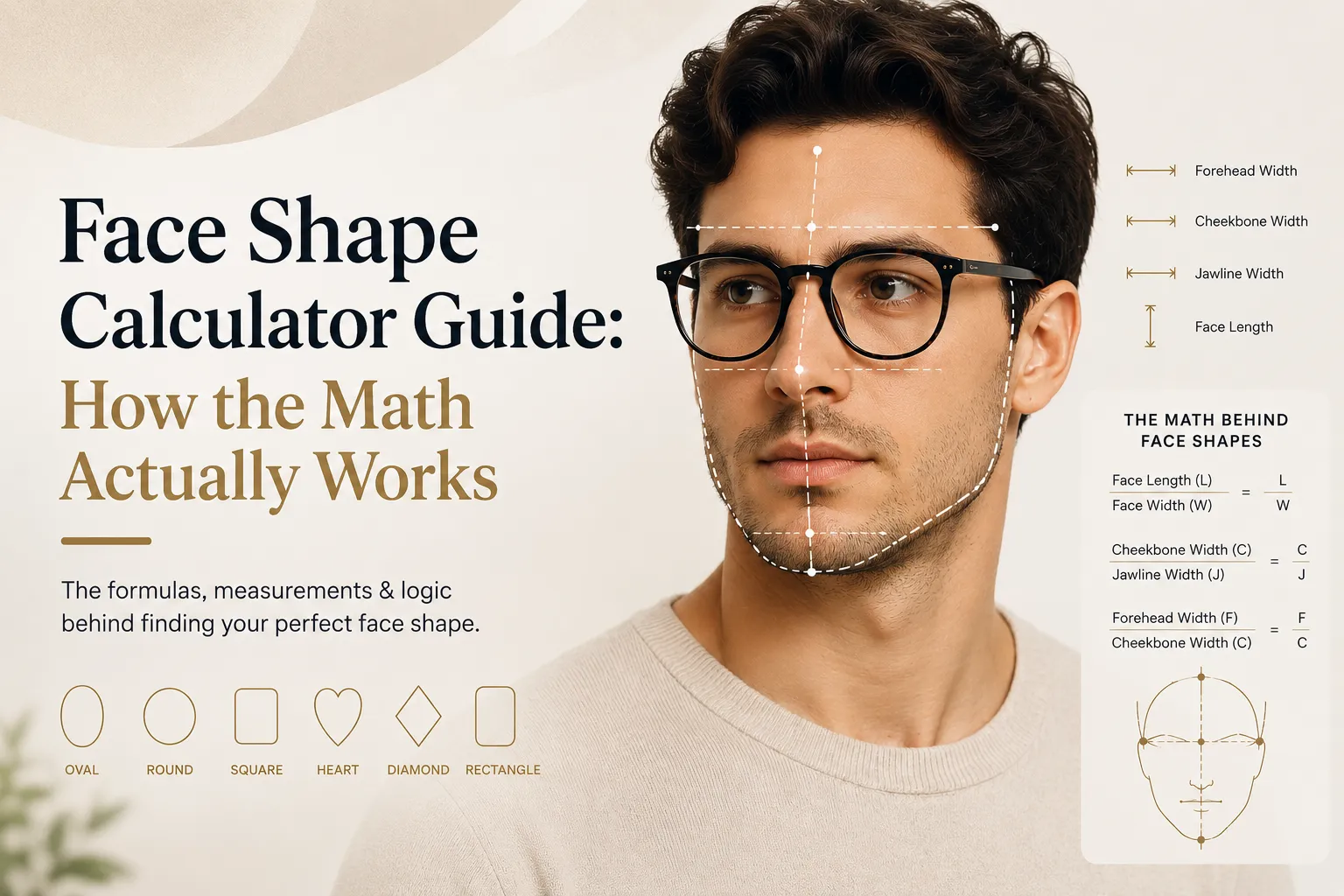

A face shape calculator sounds more technical than it actually is – under the hood, it’s just comparing a handful of measurements against each other using simple ratios, then matching the result to the closest of seven or eight standard categories. Understanding that math is useful for two reasons: it helps you judge whether a calculator’s result is trustworthy, and it means you can do the exact same calculation by hand if you’d rather skip the app entirely.
Quick version: face shape calculators compare four measurements – forehead width, cheekbone width, jaw width, and face length – as ratios to each other. The specific ratios (not the raw numbers) determine which of the standard face shapes you’re closest to. You can replicate this manually with a tape measure and basic arithmetic.
Table of Contents
- What a Face Shape Calculator Actually Measures
- The Ratios That Drive the Result
- How Calculators Turn Numbers Into a Shape
- Doing the Calculation Manually
- How Accurate Are These Tools, Really
- Where Calculators Get It Wrong
- Comparison Table of Ratio Ranges
- Tips for More Accurate Results
- When to Trust the Calculator vs. Your Own Judgment
- FAQs
- Final Thought
What a Face Shape Calculator Actually Measures
Most face shape calculators, whether they’re a simple web form or a photo-based app, rely on the same four core measurements: forehead width, cheekbone width, jaw width, and total face length. Some photo-based tools estimate these automatically using facial landmark detection, while manual calculators just ask you to input measurements you’ve taken yourself.
The Ratios That Drive the Result
The actual math comes down to a small number of ratios. Length-to-width ratio (face length divided by cheekbone width) tells you whether a face reads as long, average, or short relative to its width. Jaw-to-forehead ratio (jaw width divided by forehead width) tells you whether the face is top-heavy, bottom-heavy, or balanced. Cheekbone prominence (cheekbone width compared to both forehead and jaw width) flags diamond-shaped faces, where cheekbones clearly exceed both. These three ratios, taken together, are really the entire “algorithm” behind most calculators.
How Calculators Turn Numbers Into a Shape
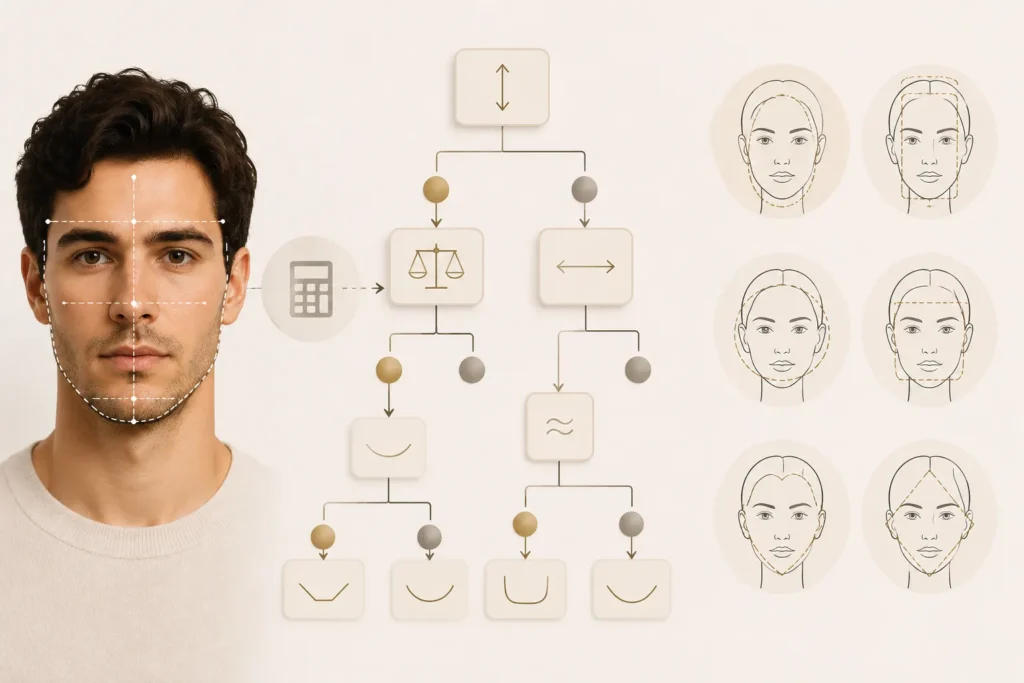
Once the ratios are calculated, a calculator essentially runs through a decision tree. High length-to-width ratio with balanced jaw-to-forehead width points toward oval, oblong, or rectangle, with jaw curvature (angular versus soft) separating those three from each other. A length-to-width ratio close to one, with balanced jaw-to-forehead width, points toward round or square, again separated by jaw curvature. A jaw-to-forehead ratio well below one points toward heart-shaped; well above one points toward triangle. And a cheekbone width that clearly exceeds both forehead and jaw points toward diamond. It’s a straightforward set of comparisons, not anything more sophisticated than that.
Doing the Calculation Manually
Measure forehead width, cheekbone width, jaw width, and face length using a soft tape measure, with your hair pulled back and the tape held straight across each time. Divide face length by cheekbone width to get your length-to-width ratio – a result noticeably above 1 suggests a longer face (oval, oblong, rectangle), while a result close to 1 suggests round or square. Divide jaw width by forehead width to get your jaw-to-forehead ratio – a result below roughly 0.9 suggests heart-shaped, above roughly 1.1 suggests triangle, and close to 1 suggests the face is balanced between the two. Finally, check whether cheekbone width clearly exceeds both forehead and jaw width by a noticeable margin – if so, diamond is worth considering regardless of what the other ratios suggest.
How Accurate Are These Tools, Really
Manual calculations are only as accurate as your measurements, so consistent technique (straight tape placement, hair fully pulled back, good lighting) matters more than which specific tool or formula you use. Photo-based calculators add another layer of potential error, since they’re estimating measurements from an image rather than a direct physical measurement – lighting, angle, and image quality all affect the result. Neither method is perfect, but both are generally close enough to give useful direction for eyewear or styling decisions.
Where Calculators Get It Wrong
Photo-based tools can misjudge measurements if the photo isn’t taken straight-on, if hair covers any part of the forehead or jawline, or if lighting creates shadows that distort where an edge actually falls. Manual calculations can go wrong if the tape measure isn’t held straight, or if measurements are taken at slightly different points each time (for instance, measuring jaw width at different heights along the jawline). Both methods also struggle with faces that genuinely sit between two categories – no calculator handles ambiguity as gracefully as a human eye can.
Comparison Table of Ratio Ranges
| Ratio | Range Suggesting This Result | Likely Face Shape Direction |
|---|---|---|
| Length ÷ cheekbone width | Notably above 1 | Oval, oblong, or rectangle |
| Length ÷ cheekbone width | Close to 1 | Round or square |
| Jaw ÷ forehead width | Below ~0.9 | Heart-shaped |
| Jaw ÷ forehead width | Above ~1.1 | Triangle |
| Jaw ÷ forehead width | Close to 1 | Balanced (check jaw curvature) |
| Cheekbone vs. forehead & jaw | Clearly widest of the three | Diamond |
Tips for More Accurate Results
Take all four measurements in one sitting rather than across multiple days, since posture and hair position can shift the numbers slightly between sessions. Use consistent reference points each time – the same spot on the jaw, the same point on the forehead – rather than eyeballing slightly different locations. If using a photo-based calculator, use a straight-on photo with even lighting and hair fully pulled back for the most reliable estimate. And if a result seems off compared to what you see in the mirror, trust your own visual judgment over the tool – calculators are a starting point, not a final verdict.
When to Trust the Calculator vs. Your Own Judgment
A calculator’s result is worth trusting when your measurements are clean and consistent, and when the result matches what you’d expect from looking in the mirror. It’s worth double-checking when the numbers land close to the boundary between two shapes, when a photo-based tool gives a result that seems visually off, or when you already suspect you’re a blend of two shapes rather than a clean match to one. In borderline cases, using both the calculator and a visual check together tends to give a more reliable answer than either method alone.
FAQs
How accurate are face shape calculators?
Reasonably accurate for most people, provided the underlying measurements are taken consistently – accuracy drops mainly due to measurement error, not flawed logic.
Can I calculate my face shape manually without an app?
Yes – all you need is a soft tape measure, a mirror, and basic division to calculate the same ratios most calculators use.
What measurements does a face shape calculator use?
Forehead width, cheekbone width, jaw width, and total face length are the four core measurements behind nearly every calculator.
Why do photo-based calculators sometimes get it wrong?
Lighting, camera angle, and hair covering part of the face can all distort the measurements a photo-based tool estimates.
What ratio determines if my face is long or short relative to its width?
Dividing face length by cheekbone width gives you this ratio – notably above 1 suggests a longer face, close to 1 suggests a shorter, wider one.
How do calculators tell heart-shaped from triangle-shaped faces?
By comparing jaw width to forehead width – a narrower jaw relative to the forehead suggests heart-shaped, while a wider jaw suggests triangle.
What if my results fall right on the boundary between two shapes?
That’s common, and it usually means you’re genuinely a blend of both shapes – it’s fine to use frame advice from both relevant guides.
Do I need special equipment to use these formulas myself?
No, just a soft tape measure or a piece of string and a ruler, plus a mirror.
Should I trust a calculator over my own visual judgment?
Not necessarily – if a result seems clearly off compared to what you see in the mirror, your own visual judgment is worth weighing alongside the calculator’s output.
Does the same math apply to every face shape calculator, or do they vary?
The core ratios (length-to-width, jaw-to-forehead, cheekbone prominence) are fairly standard across most calculators, though the exact thresholds used to draw category boundaries can vary slightly between tools.
Final Thought
A face shape calculator isn’t running anything more complex than a handful of measurement ratios compared against standard ranges – which means you can replicate the exact same process by hand with a tape measure and basic division. Treat any calculator’s result as a solid starting point, cross-check it against your own reflection, and don’t worry if you land between two categories rather than squarely in one.
This article is for informational purposes only and does not constitute medical advice. Please consult a qualified eye care professional for personalised guidance.
We strive to keep our content accurate and up to date, but information may change over time. Please verify important details with official sources or eye care professionals.
