












Quick Answer : The most common eyeglass buying mistakes are: choosing frames by style alone without checking face shape or fit, skipping anti-reflective coating, ignoring pupillary distance (PD) when buying online, using an outdated prescription, and choosing lens material without considering prescription strength. Each leads to glasses that are uncomfortable, unflattering, or optically compromised.
Most people buy glasses every couple of years at most – and the process is unfamiliar enough that the same errors recur across buyers of all ages and experience levels. Some are small inconveniences; others cost real money or actively compromise your vision quality for years.
These are the ten mistakes that come up most consistently – and exactly what to do instead.
Mistake 1: Choosing Based on Style Without Checking Fit
This is the most universal error. A frame that looks extraordinary on a display stand or product page can look entirely wrong on your face – not because it is a bad frame, but because it does not suit your face shape, proportions, or skin tone.
What to do instead: Know your face shape first. It takes two minutes and changes how you evaluate every frame. Someone with a square face should prioritise round and oval options; someone with an oval face has a wider range but still needs to check proportion. The Nayanva Face Shape Guides cover every common face type with specific frame recommendations, including the guides for oval faces and square faces.
Mistake 2: Getting the Frame Width Wrong
Frame width is the measurement most frequently ignored and most immediately visible when wrong. Frames too wide make your face look narrow; frames too narrow look pinched and undersized.
How to check: Measure the widest point of your face (typically at the temples or cheekbones depending on your face shape). Compare to the total frame width in the product specifications. Most frames fall between 130mm and 145mm total width. Your face width should roughly match or sit very close to the frame width.
Expert Tip
When shopping online, check the three key frame measurements: lens width, bridge width, and temple arm length – typically listed as ‘LW-BW-TL’ (e.g., 52-18-140). The guide on How to Choose Eyeglasses Online Without Making Mistakes explains exactly how to use these numbers to confirm fit before buying.
Mistake 3: Skipping Anti-Reflective Coating
AR coating is the most frequently declined lens upgrade – and the one with the most consistent, daily impact on visual quality. People skip it to reduce cost; then spend years dealing with ghost reflections and screen glare they cannot identify as the problem.
Premium multi-layer AR coatings reduce reflections across the visible spectrum, include scratch resistance, repel smudges, and make lenses dramatically cleaner in appearance. For screen workers, they are functional necessities. For anyone, they are the upgrade most worth paying for when choosing prescription lenses.
Mistake 4: Using an Outdated Prescription
Prescriptions change. Wearing an outdated prescription means your glasses are correcting for a version of your eyes that no longer exists. For most people this means reduced clarity; for others it causes headaches and eye fatigue attributed to other sources.
If your most recent eye examination was more than two years ago (one year for children), book an update before buying new glasses. The cost of an examination is significantly less than ordering frames you will need to replace.
Mistake 5: Not Knowing Your Pupillary Distance (PD)
Pupillary distance (PD) is the millimetre measurement between the centres of your pupils. It tells lens makers exactly where to place the optical centre of the lens within the frame. Misaligned optics means you are not looking through the correct part of the lens — causing visual discomfort and headaches that are hard to trace to the real source.
For in-person purchases, opticians measure PD as standard. For online purchases, you need to know your own PD. Ask for it at your next eye examination (opticians are required to provide it in most countries), measure it at home with a ruler and mirror, or use a virtual try-on tool that includes PD calculation. A PD error of just 2-3mm can cause persistent visual discomfort that is difficult to identify without knowing what to look for.
Mistake 6: Choosing the Wrong Lens Material for Your Prescription
Not all prescription strengths work equally well in all lens materials. Strong prescriptions in particular need careful selection:
- Strong prescriptions in standard CR-39 plastic create noticeably thick, heavy lenses
- High-index lenses (1.67 or 1.74) are significantly thinner and lighter for the same correction
- Rimless and semi-rimless frames look elegant but require thicker lenses to avoid edge chipping – often incompatible with high prescriptions
Ask your optician which lens material and index is recommended for your specific prescription. For a prescription of -4.00 or stronger, or +3.00 or stronger, high-index lenses make a meaningful practical difference to how the glasses look and feel on your face.
Mistake 7: Ignoring Frame Material for Your Lifestyle
Buying acetate frames when you are active and outdoors, or heavy stainless steel for lightweight everyday professional wear – frame material should match how you actually live, not just how you look in the frames at the moment of purchase.
A quick guide:
- Active lifestyles, sports, children: TR-90 nylon or titanium – flexible, light, impact-resistant
- Everyday professional wear: Titanium or quality acetate – balance of lightness and style
- Style-prioritised fashion wear: Acetate – unmatched colour and design range
- Sensitive skin or metal allergies: Titanium or acetate – both hypoallergenic
The complete breakdown of every major material’s properties is in Best Frame Materials Explained.
Mistake 8: Buying Tinted Sunglasses Without Checking UV Protection
When people add tint to prescription glasses, they frequently select a shade without confirming UV400 certification. A medium grey tint looks like effective sun protection – but without UV400, it offers no UV protection and may actively increase UV exposure by dilating pupils in what feels like shade.
Always confirm UV400 certification separately from lens tint, regardless of how dark the lenses appear. The full explanation of how UV protection works – and why tint darkness is irrelevant – is in UV Protection in Sunglasses Explained.
Mistake 9: Buying Online Without Knowing Returns Policy or Frame Measurements
Online eyewear has matured significantly and many excellent frames are available online at meaningfully lower prices than high-street opticians. But buying online without either a virtual try-on tool or a clear returns policy is an unnecessary gamble.
What to confirm before buying online:
- Free returns or exchange period – 30 days is standard with reputable online retailers
- Virtual try-on tool that uses your actual face rather than a model
- Clear frame measurements listed so you can compare to frames you already own and know fit well
- Full prescription entry including PD and any add-power for progressives
The complete guide on How to Choose Eyeglasses Online Without Making Mistakes walks through every element of a successful online purchase.
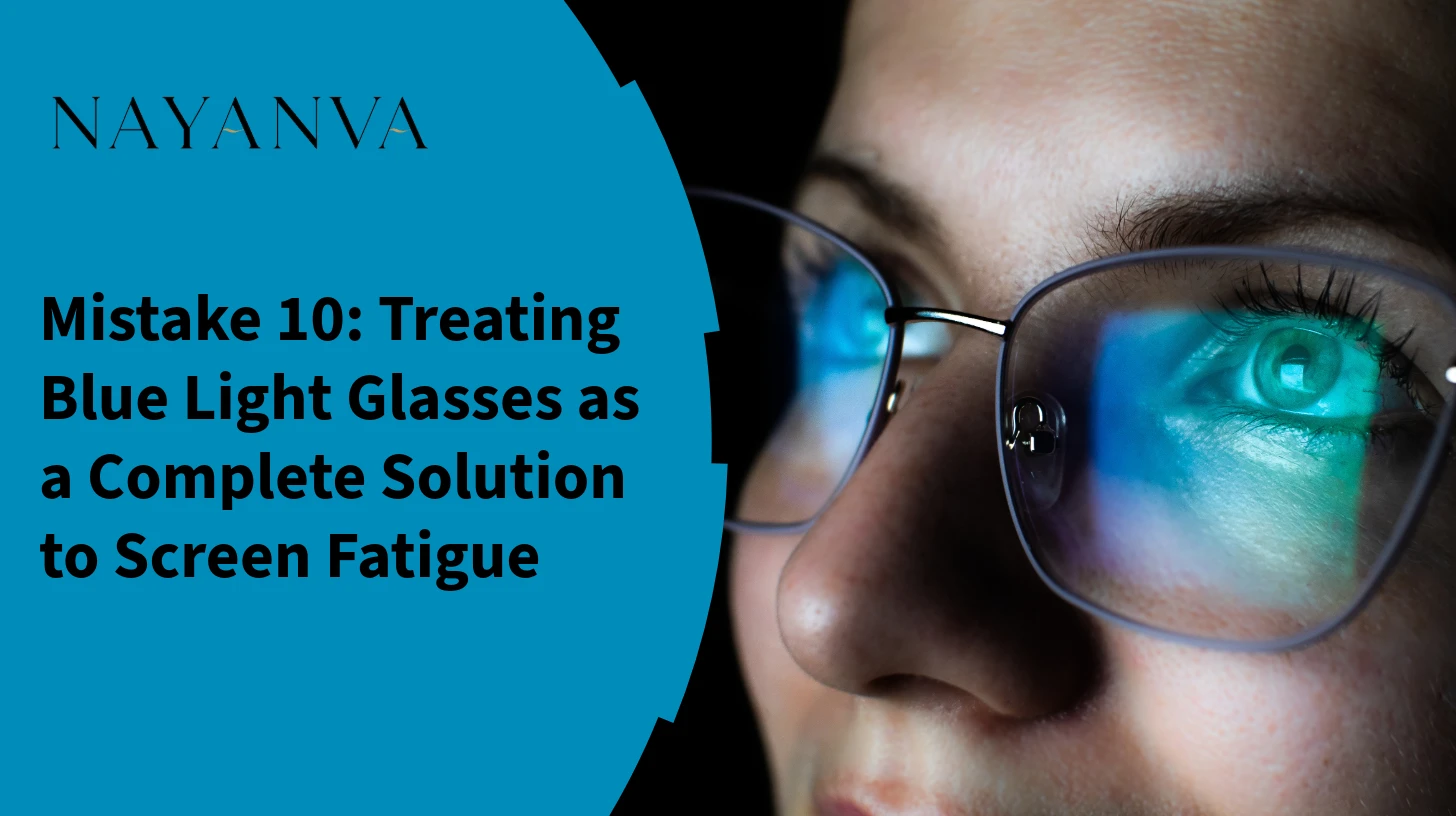
Mistake 10: Treating Blue Light Glasses as a Complete Solution to Screen Fatigue
Blue light filtering glasses have been heavily marketed as solutions to eye strain, headaches, and screen fatigue. The reality is more nuanced. For most screen-related eye fatigue, an incorrect prescription or missing AR coating is a more significant factor than blue light itself.
Blue light glasses are a supplement, not a substitute for a correct prescription and proper lens coating. They have legitimate potential benefit for evening screen users concerned about sleep disruption, but they will not compensate for wearing an incorrect prescription at a screen. The current research is reviewed fully in Blue Light Glasses: Do They Really Work?
Expert Tip
If your current glasses feel ‘almost right’ but something is persistently off, do not simply reorder the same prescription. Book an eye examination – a small prescription shift or a PD discrepancy is very commonly the underlying cause of that hard-to-identify visual discomfort.
What is the most common mistake when buying glasses?
Choosing frames based purely on how they look on a display or model, without considering face shape, frame width relative to face width, or whether proportions suit their features. The second most common is skipping AR coating – the upgrade that most consistently affects daily visual quality.
How do I avoid buying glasses online that don’t fit?
Measure your existing glasses if you have a pair that fits well – compare lens width, bridge width, and temple length to the listed measurements of online options. Use virtual try-on tools where available. Buy from retailers with free return policies so you can test fit at home.
Should I always go to an optician rather than buying online?
An optician is essential for eye examinations, prescription updates, and professional fitting advice. Online purchase is a valid option for replacing frames with a confirmed current prescription – particularly once you know your PD and the frame measurements that suit you. The two approaches complement each other.
Why do new glasses give me headaches?
The most common causes are: incorrect PD (optical centres misaligned with pupils), prescription error, missing AR coating causing fatigue from screen reflections, or the normal adjustment period for a new prescription or first progressive lenses. If headaches persist beyond 1-2 weeks, return to the optician who dispensed the glasses.
Is it a mistake to buy very cheap glasses?
Price alone is not the quality indicator. Very cheap glasses from unverified sources often have inconsistent lens quality, absent coating standards, and unverified UV certification. Budget options from reputable retailers with clear product specifications are generally sound; unbranded ultralow-cost glasses from unverified online sources carry the most risk.
Key Takeaways
- Know your face shape before selecting frames – it immediately filters out unsuitable options and focuses your choices.
- Know your pupillary distance (PD) before buying online – a few millimetres of error causes persistent discomfort.
- AR coating is the most impactful lens upgrade for daily glasses, especially for screen and office workers.
- Use an up-to-date prescription – buying new glasses against an outdated one wastes money and compromises vision.
- Match frame material to your lifestyle: titanium or TR-90 for active use, acetate for style priority.
- Online buying is valid – but only with clear return policies and carefully confirmed frame measurements.
- Blue light glasses are a supplement to correct prescriptions and proper coatings, not a substitute for them.
This article is for informational purposes only and does not constitute medical advice. Please consult a qualified eye care professional for personalised guidance.
We strive to keep our content accurate and up to date, but information may change over time. Please verify important details with official sources or eye care professionals.