












Quick Answer: To choose eyeglasses online successfully, you need three things: a current prescription with your pupillary distance (PD) measurement, your correct frame size (from an existing pair or face measurement), and a clear idea of which frame shapes suit your face. Most online eyewear mistakes are avoidable with these basics in place.
Buying glasses online can save you significant money and give you access to far more frame variety than any physical store. But it’s also easy to get it wrong – and ending up with glasses that don’t fit, don’t work with your prescription, or just look odd on your face is frustrating and costly.
Most mistakes aren’t about the glasses themselves. They’re about missing a critical piece of information before clicking purchase.
Step 1: Understand Your Prescription
Prescription abbreviations trip people up constantly. Here’s what you’re looking at:
- SPH (Sphere): The primary power of your lens. Negative (-) = nearsightedness; positive (+) = farsightedness
- CYL (Cylinder): Power needed to correct astigmatism
- AXIS: A number from 1–180 specifying the orientation of your astigmatism correction
- ADD: Addition power for reading glasses or progressive lenses
- OD / OS: Right eye (OD) and left eye (OS) – swapping these is a surprisingly common mistake
Your prescription must be current. Most prescriptions are valid for 1–2 years. Using an outdated prescription will give you lenses that may no longer correct your vision properly.
Step 2: Get Your Pupillary Distance (PD)
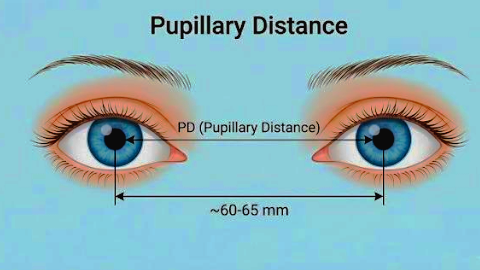
Your pupillary distance (PD) is the measurement in millimetres between the centres of your pupils. It’s how opticians centre the prescription correctly within the lens. Get this wrong and the optical centre won’t line up with your eye – expect headaches, eye strain, and distorted vision.
How to Get Your PD
- Ask your optician – request it explicitly, as not all include it automatically
- Measure it yourself with a ruler and mirror: align zero with your left pupil (right eye closed), then read the measurement to your right pupil (left eye closed). Repeat for accuracy.
- Use a dedicated PD measuring app from a reputable source
PD is given as a single number (e.g., 64mm) or as dual PD (e.g., 32/31mm). Both are fine to provide.
Step 3: Know Your Frame Size
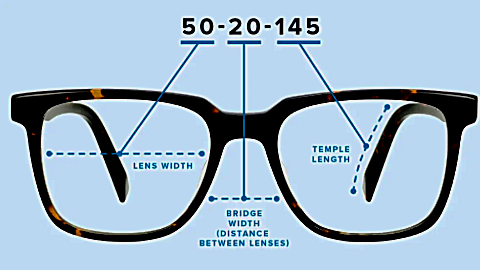
Frame size is the single biggest source of disappointment in online glasses purchases. Frames that look good on a model may be completely wrong for your face.
Reading Frame Size from an Existing Pair
Look inside the temple arm of a pair you already own. You’ll find a sequence like: 52-17-140
- 52 = lens width in mm
- 17 = bridge width in mm
- 140 = temple length in mm
These three measurements are your baseline. Shop within 2–3mm of each measurement.
Step 4: Choose the Right Lens Type
- Single Vision: Corrects one focal distance – the most straightforward and affordable option
- Progressive / Multifocal: Corrects near, intermediate, and distance vision. Buy your first pair of progressives in-store.
- Blue Light Filtering: Worth considering for heavy computer users – see our blue light glasses guide
- Anti-Reflective (AR) Coating: Reduces glare from screens and headlights. Almost always worth adding.
- Photochromic Lenses: Darken in UV light, clear indoors – convenient for variable conditions
- Polarized Lenses: Primarily for sunglasses – reduces glare from reflective surfaces
Common Online Glasses Buying Mistakes
| Mistake | Why It Happens | How to Avoid It |
| Wrong frame size | Not measuring existing frames | Always check the size numbers first |
| Incorrect PD | Optician didn’t include it | Ask explicitly; measure yourself if needed |
| Outdated prescription | Using old glasses paperwork | Confirm the date on your prescription |
| OD/OS reversed | Confusing left and right eye | Double-check before submitting order |
| Skipping AR coating | Trying to save money | Add it – the difference in glare is significant |
| Buying progressives online first-time | Complex fitting requirements | Buy first progressives in-store |
| Not reading return policy | Excitement of purchase | Check this before adding anything to cart |
Lens Index: Don’t Skip This
If your sphere power is above ±3.00, think about lens index. Standard (1.50) lenses become noticeably thick at higher powers.
- Up to ±3.00 SPH: 1.50 index is fine
- ±3.00 to ±5.00: 1.60 index recommended
- ±5.00 to ±7.00: 1.67 index strongly recommended
- ±7.00+: Consider 1.74 index
Expert Tips for First-Time Online Buyers
Order two pairs. Online glasses are often significantly more affordable than in-store, so a backup pair makes sense financially.
Don’t jump straight to a fashion-forward frame. Your first online order should be a safe, classic shape close to what you already know works.
Check frame reviews. Many retailers include real customer photos that show how frames look on actual faces far more accurately than product shots.
Visit an optician to get new glasses adjusted after they arrive. Most will do a quick fitting for free even if you didn’t buy from them.
FAQ: Buying Glasses Online
Is it safe to buy prescription glasses online?
Yes, from reputable retailers. The key is having an accurate, current prescription and correct PD measurement. The lenses are made from the same optical materials as in-store glasses.
How do I know what size glasses to order online?
Check the three numbers inside your current glasses’ temples: lens width / bridge width / temple length. Order within 2–3mm of those numbers for a comparable fit.
What is pupillary distance and why does it matter?
PD is the distance between the centres of your pupils. It’s used to centre the optical prescription in each lens directly in front of your eyes. Incorrect PD causes visual discomfort, eye strain, and distorted vision.
Can I buy progressive lenses online?
You can, but it’s more complex than single vision. Progressive lenses require additional fitting measurements and benefit from in-person expertise. If you’re new to progressives, start with an in-store fitting.
Key Takeaways
- Your prescription (with current date and PD) is the foundation of any online glasses purchase
- Frame size numbers inside existing glasses are your most reliable sizing reference
- Anti-reflective coating is almost always worth adding
- Buy progressives in-store for your first pair; single vision online is straightforward
- Always check return and remake policies before purchasing
This article is for informational purposes only and does not constitute medical advice. Please consult a qualified eye care professional for personalised guidance.
We strive to keep our content accurate and up to date, but information may change over time. Please verify important details with official sources or eye care professionals.



Very helpful guide! The tips about PD measurement and frame sizing are especially useful for avoiding costly mistakes when buying glasses online.
[…] Features That Actually Matter June 14, 2026 Blue Light Glasses: Do They Really Work? June 14, 2026 How to Choose Eyeglasses Online Without Making Mistakes June 14, 2026 […]
[…] Features That Actually Matter June 14, 2026 Blue Light Glasses: Do They Really Work? June 14, 2026 How to Choose Eyeglasses Online Without Making Mistakes June 14, 2026 […]