





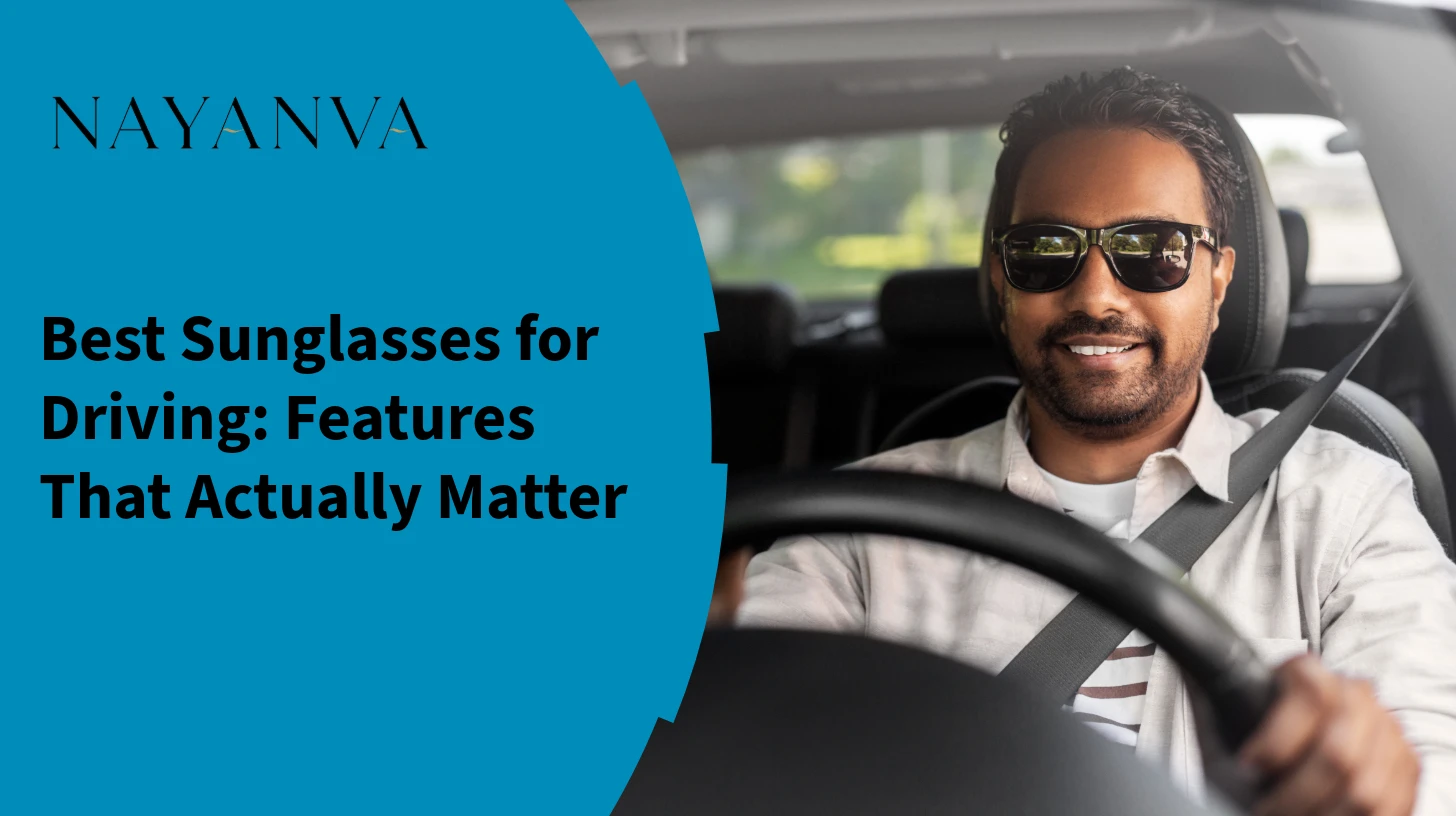

Quick Answer: The best sunglasses for driving combine Category 2 or 3 lens darkness, polarized lenses for glare reduction, UV400 protection, and a wraparound or close-fitting frame. Avoid very dark Category 4 lenses (dangerous in tunnels and low light) and heavily mirrored lenses. Grey or brown tints are best for accurate color perception – critical when reading traffic signals.
Most people buy sunglasses based on how they look. For everyday wear, that’s fine. But driving sunglasses need to meet a different set of criteria – because on the road, what your lenses do matters as much as what they look like.
Poor driving sunglasses can actually be more dangerous than no sunglasses at all. Overly dark lenses reduce critical contrast in changing light. The wrong tint distorts traffic signal colors. Low-quality polarization creates odd visual artefacts on digital dashboards. These aren’t minor issues.
Lens Darkness: Understanding the Category System
| Category | Light Transmission | Best Use |
| 0 | 80–100% | Overcast conditions, indoor |
| 1 | 43–80% | Low sunshine, cloudy |
| 2 | 18–43% | Moderate sunlight, most driving |
| 3 | 8–18% | Strong sunlight, most driving |
| 4 | 3–8% | Extreme conditions (high altitude, snow) – NOT for driving |
For driving, Category 2 or 3 is the right choice. Category 4 lenses are not suitable for driving – they’re too dark for variable light conditions, and entering a tunnel with Category 4 lenses creates a genuine hazard.
Polarization: Essential for Driving
Polarized lenses are arguably the most important feature in driving sunglasses. Standard lenses reduce overall light. Polarized lenses specifically block horizontally polarized light – the type of glare that comes from wet roads, standing water, car hoods, and windscreens.
The visual difference on the road is dramatic. Wet road glare, which can be genuinely blinding in direct sun, is almost completely eliminated by good polarized lenses. This is a safety feature, not a luxury.
One important caveat: some digital displays – GPS screens, certain dashboard instruments – can appear dark or show grid patterns when viewed through polarized lenses at certain angles. Check your specific dashboard compatibility before committing.
UV Protection: Non-Negotiable
Look for UV400 protection – this means the lens blocks all light below 400 nanometres (covering both UVA and UVB). A car windscreen blocks some UV, but side windows typically block far less. UV radiation causes cumulative damage including increased risk of cataracts and macular degeneration.
Note: UV400 is not the same as Category 3 darkness. A lens can be lightly tinted and still provide full UV400 protection – they’re separate properties.
Lens Tint Color: Why It Matters More Than Most Realize
Grey (Smoke) Tint
Reduces light uniformly across the spectrum with minimal color distortion. Best overall for driving – traffic signals read accurately. Particularly good in very bright conditions.
Brown / Amber Tint
Enhances contrast in hazy or lower-light conditions. Slight warm toning with minor color shift. Excellent for rural and motorway driving with variable conditions. Many drivers find it easier on the eyes over long distances.
Yellow / Orange Tint
High contrast in low-light conditions. Marketed for overcast and dawn/dusk driving. Does distort color – traffic signal differentiation requires more attention.
Green Tint
Similar to grey in color neutrality. Good contrast without significant distortion. Popular in classic aviator styles.
What to Avoid
Very heavy rose, bright orange, or red tints for driving. Anything that makes traffic lights harder to distinguish is a safety risk.
Frame Design: Fit Matters for Driving
The frame shape affects how much of your peripheral vision is covered by the lens – relevant for shoulder checks and reading side mirrors.
- Wraparound and semi-wraparound frames are the best choice – they protect against lateral light, reduce peripheral glare, and stay in place during head movements
- Flat fashion frames with narrow lenses or large gaps at the temple let in lateral glare, which can worsen driving conditions
- Frames should sit comfortably close to the face without touching the cheekbones
- Temples shouldn’t pinch – sustained pressure causes headaches over long drives
- Frames shouldn’t slide down the nose when you tilt your head to check mirrors
Night Driving Glasses: The Honest Assessment
Yellow-tinted night driving glasses are heavily marketed but have limited evidence for improving night vision. They can reduce glare from oncoming headlights, but they also reduce overall light transmission – which reduces visibility in the already-dark driving environment.
Multiple driving safety organisations, including the AAA, have found they don’t meaningfully improve driving performance at night and may marginally worsen it.
The better solution for night driving difficulties is a visit to an optometrist. Night driving problems often indicate uncorrected refractive errors (particularly astigmatism), which a proper prescription addresses far better than a yellow tint.
Prescription Driving Sunglasses
If you wear prescription glasses, you have several options:
- Prescription tinted lenses: The most optically precise option – your prescription in a sunglass-style frame with tinted, polarized lenses
- Photochromic / transition lenses: Convenient for variable conditions. Look for ‘xtractive’ variants designed to work inside vehicles (regular photochromics can be slow to darken behind a windscreen)
- Clip-on polarized lenses: Practical, affordable, and optically reasonable
- Over-glasses (OTG) sunglasses: Designed to fit over prescription glasses – bulkier but functional
Quick Reference: Best Driving Sunglasses Features
| Feature | Recommendation |
| Lens category | Category 2-3 |
| Tint color | Grey or brown |
| Polarization | Yes – strongly recommended |
| UV protection | UV400 essential |
| Frame style | Wraparound or close-fitting |
| Night driving | Not recommended with tinted lenses |
| Category 4 lenses | Avoid for driving |
| Mirror coating | Optional, avoid very dark mirror |
Expert Tips
Test your lenses on a phone screen or digital display before your journey. Some polarized lenses interact poorly with certain screen angles – better to know in advance.
Keep a Category 1 or 2 pair in the car for overcast days. Wearing Category 3 lenses on a grey day reduces contrast precisely when you need it most.
When buying driving sunglasses online, confirm the lens category rating – not just descriptors like ‘dark’ or ‘medium.’ The formal category classification is far more useful.
Clean your lenses before every drive. A fingerprint on a polarized lens creates visual artefacts that are distracting at best and dangerous at worst.
FAQ: Best Sunglasses for Driving
Are polarized sunglasses better for driving?
Generally yes. Polarized lenses significantly reduce horizontal glare from wet roads, water, and reflective surfaces – a genuine safety improvement. The only consideration is compatibility with digital displays, which some drivers find a minor issue.
What color lens is best for driving?
Grey and brown tints are the best choices. Grey provides the most neutral color perception (important for traffic signals). Brown enhances contrast in variable light. Both are well-suited to a wide range of driving conditions.
Can you drive with Category 4 sunglasses?
No – Category 4 sunglasses are not suitable for driving. They’re too dark for variable light conditions and are prohibited for driving in many countries. They’re designed for extreme brightness environments like skiing at altitude.
Do yellow-tinted glasses help with night driving?
Evidence is limited and somewhat negative. Yellow lenses reduce glare but also reduce overall light transmission. Most driving safety research does not recommend them. If you struggle with night driving, see an optometrist – it may indicate a correctable prescription issue.
What UV protection should driving sunglasses have?
UV400 is the standard to look for. It means the lens blocks all light below 400 nanometres. Car windscreens block more UV than side windows, so full UV protection remains important.
Can I wear clip-on polarized lenses over my prescription glasses while driving?
Yes. Good clip-on polarized lenses work well for driving. Make sure they sit flush with your frames without gaps, and that they don’t create optical distortion at the centre of your prescription lenses.
Key Takeaways
- Category 2 or 3 lenses are correct for driving; avoid Category 4
- Polarized lenses provide genuine glare reduction on roads – a safety benefit
- UV400 protection is non-negotiable for eye health
- Grey or brown tints preserve color accuracy; avoid red or bright orange for driving
- Wraparound frames reduce peripheral glare and stay in place during head movements
- Night driving glasses lack strong evidence; see an optometrist if night vision is a recurring issue
This article is for informational purposes only and does not constitute medical advice. Please consult a qualified eye care professional for personalised guidance.
We strive to keep our content accurate and up to date, but information may change over time. Please verify important details with official sources or eye care professionals.


Very impressed with these sunglasses. They look premium, fit perfectly, and provide excellent protection from sunlight. Great choice for driving, traveling, and everyday use.
[…] Men June 15, 2026 Best Glasses for Oval Face Men: Top Frame Styles That Always Work June 14, 2026 Best Sunglasses for Driving: Features That Actually Matter June 14, 2026 […]
[…] Men June 15, 2026 Best Glasses for Oval Face Men: Top Frame Styles That Always Work June 14, 2026 Best Sunglasses for Driving: Features That Actually Matter June 14, 2026 […]